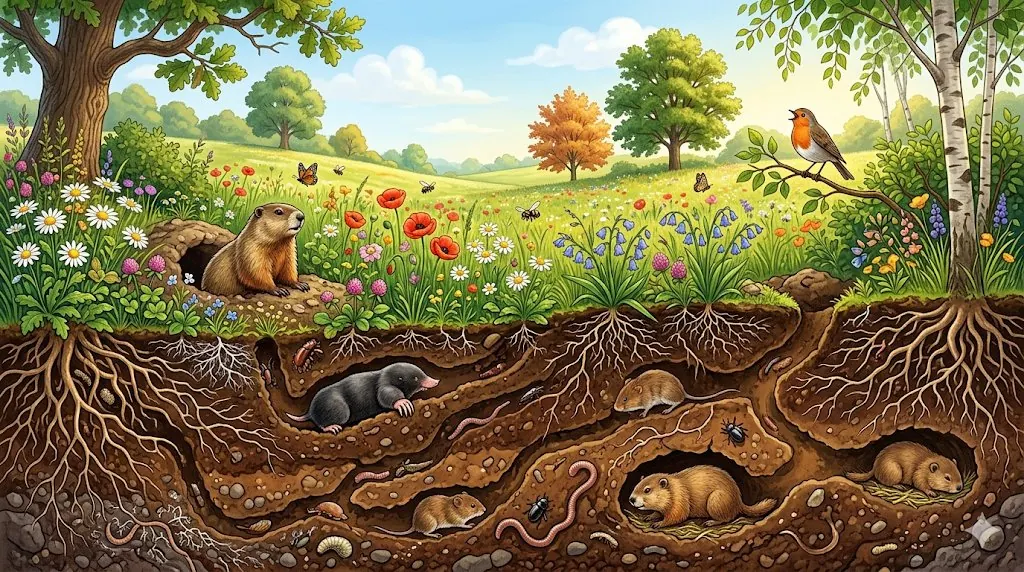
Most people understand green burial in the abstract — no embalming, no vault, a simple shroud or wooden casket. Fewer have thought through what that actually means underground. It's a fair question to avoid in casual conversation, but it's worth answering honestly, because the science behind it is the entire point of choosing this kind of burial in the first place.
The Process, in Stages
Decomposition unfolds in a predictable sequence, regardless of where it happens. In the hours after death, the body's temperature equalizes with its surroundings and internal bacteria — already present in the gut — begin breaking down tissue from the inside. Within days, microbial activity intensifies and gases build up as a byproduct, a stage forensic scientists call "bloat." From there, decomposition moves into "active decay," where soft tissues break down rapidly with help from soil microbes, insects, and naturally occurring enzymes, followed by "advanced decay," and eventually skeletonization, where mineralized bone is what remains.
This is true of any burial, embalmed or not. What differs is how completely — and how quickly — that process is allowed to run its course.
Why Shallow and Unsealed Matters
Natural burial practice favours graves shallow enough that the body rests within the upper few feet of soil — typically in the range of three to four feet to the base of the grave. That depth isn't arbitrary. The upper layer of soil is where oxygen, moisture, and microbial life are richest, which is exactly what's needed for aerobic decomposition: the kind that happens efficiently, with the help of bacteria and fungi that depend on oxygen to do their work. Bury a body too deep, or seal it inside a concrete vault, and you cut off that oxygen supply. Decomposition still happens, but it slows dramatically and shifts toward anaerobic processes that are far less efficient at returning the body's components to the surrounding ecosystem.
This is the core trade-off between green and conventional burial. A concrete vault and embalming chemicals are designed to preserve the body and slow its breakdown for as long as possible. A shrouded or simply-cased body, buried directly in living soil, is designed to do the opposite — to decompose fully and contribute its nutrients back to the land above it. It's the same underlying trade-off explored from a different angle in our comparison of green burial and cremation.
What was once a body becomes, over a handful of years, simply soil — richer than what surrounded it, and quietly feeding everything growing above.
A "Decomposition Island," Not a Void
Ecologists who study this have a useful term for what happens around a naturally buried body: a "cadaver decomposition island." As soft tissue breaks down, the surrounding soil absorbs a concentration of organic compounds — nitrogen, phosphorus, carbon — that nearby plant roots draw on directly. Far from being inert, the area around a green burial becomes, for a period of years, one of the more nutrient-rich patches of soil in the cemetery. It's the literal mechanism behind something this directory's homepage already says: the body nourishes the soil and supports the ecosystem around it. That isn't a poetic flourish — it's a description of measurable soil chemistry.
Timeline, and What Families Typically Wonder About
In Canadian conditions, full skeletonization in a properly prepared green burial grave generally takes somewhere in the range of eight to twelve years, depending on soil composition, local climate, and whether the body was wrapped in a shroud or a more substantial wooden casket. Colder regions and harsher Canadian winters slow the process; warmer, more biologically active soils speed it along.
The two concerns families raise most often — odour and groundwater contamination — are both addressed by the same mechanism: soil itself acts as a filter. Any gases produced during decomposition are largely absorbed and broken down by the surrounding soil microbes before they reach the surface, and that same soil binds and neutralizes the organic compounds released during decay rather than allowing them to migrate. Setbacks from water sources, required at any properly run cemetery, add a further layer of protection. There are no documented cases of wildlife disturbing a properly depth-buried grave at a managed natural burial ground — the soil cover itself is the barrier.
The Short Version
Green burial doesn't avoid decomposition or try to disguise it. It works with it — using depth, soil biology, and the absence of preservative chemicals to let a body return its components to the earth in a way that's faster, more complete, and more ecologically active than a sealed, embalmed burial allows. It's the same process that's been quietly happening in unmarked ground for most of human history. Green burial just does it deliberately, and with consent.
See which Canadian cemeteries actually allow direct earth burial.
View the Directory →